
This form of the Divine Mother is striking. It is difficult not to feel a sense of visceral jolt or unease when encountering Her image for the first time. Not surprisingly, there are very few temples or shrines dedicated to Her. And yet, She is one of the Mahāvidyās, the great forms of the Divine Mother who bestow supreme knowledge upon the sincere sādhaka. For one who approaches Her with devotion, there arises a natural question: there must be more to Her than what first meets the eye.
Devī Chinnamastā is depicted as a fierce goddess standing in a dynamic posture, usually naked, with her hair flowing freely. She stands upon a couple in union, often identified as Kāma and Rati, positioned on a lotus. Her most defining feature is that She has severed Her own head, which She holds in one hand, while Her headless body remains upright. From Her neck flow three streams of blood. One stream enters Her own severed head, while the other two are received by two attendants standing on either side of Her, often identified as Jayā and Vijayā, who drink from the flowing streams. You can read the origins of Devī Chinnamastā in my post here.
In my post on The Forms of Daśa Mahāvidyā, I wrote that these form are not meant to comfort or please the senses. Rather, they are meant to awaken the mind in a sudden way, and this is often what happens when we first encounter their iconography. A similar response arises in the presence of Devī Chinnamastā.
For one who remains fixed only on the outward appearance of Mother Chinnamastā, the response rarely moves beyond fear, repulsion, or a kind of distorted fascination that arises from shock and intensity. But for the sādhaka who is ready, She invites them to discover the sacred even within what appears forbidden and unsettling.
Unlike Mother Kālī, who holds a severed head in Her hand, Mother Chinnamastā is depicted as severing Her own head, not in a self-destructive way, but as a radical expression of self-offering and nourishment. She is described as the ultimate nourisher of the universe. Yet there is also something in Her that feels closely connected to Mother Kālī. In fact, some of Her names are also names of Mother Kālī. Within Mother Chinnamastā’s nature lies a paradoxical duality: She appears fierce and wrathful, and yet She is simultaneously the embodiment of compassion and nourishment.
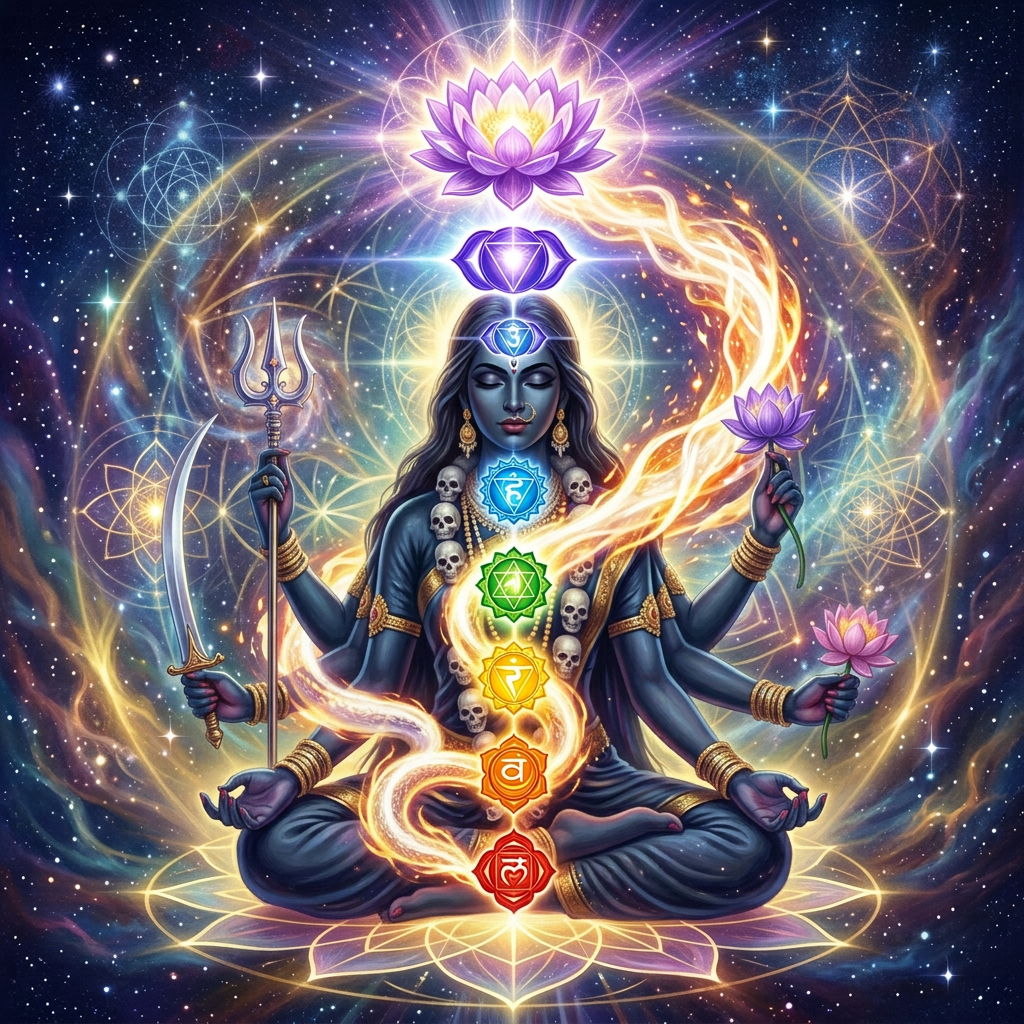
Esoterically, Devī Chinnamastā is the upward unfolding of Kuṇḍalinī śakti, the Divine Mother in Her most subtle form, resting within the depths of being until awakened through sādhanā. To understand Kuṇḍalinī, we have to first understand nāḍīs and prāṇa.The body is said to be woven with subtle channels, nāḍīs, through which prāṇa flows. Prāṇa is the breath of life itself, the quiet force that animates and sustains embodied existence. Among these nāḍīs, there are three primary ones: iḍā, piṅgalā, and suṣumṇā. Suṣumṇā runs centrally, while iḍā and piṅgalā are on either side of it, forming a triadic structure through which prāṇa circulates.
For most people, Kuṇḍalinī remains asleep, and prāṇa moves ceaselessly between iḍā and piṅgalā. This oscillation becomes the rhythm of ordinary consciousness, where the mind is carried between attraction and aversion, joy and sorrow, pleasure and pain. At rare moments, prāṇa may briefly enter suṣumṇā, but for the most part this central channel remains inactive or obstructed. When Kuṇḍalinī awakens, prāṇa begins to flow primarily through suṣumṇā.
In the sacred iconography of Devī Chinnamastā, the central form of the Goddess reveals this very mystery. She is the awakened suṣumṇā, opened through grace and sādhanā, while Her attendants embody iḍā and piṅgalā, receiving the flow that once moved only between them. In this inner vision, it is suṣumṇā that sustains all movement, quietly nourishing the lateral nāḍīs rather than being shaped by them.
In this way, Devī Chinnamastā points toward the rising of Kuṇḍalinī śakti and the reversal of ordinary energetic flow within the subtle body.
References
Chinnaiyan, K. (2019). Glorious alchemy: Living the Lalitā Sahasranāma. New Sarum Press.
Kempton, S. (2013). Awakening Shakti: The transformative power of the goddesses of yoga. Sounds True.
Kinsley, D. R. (1997). Tantric visions of the divine feminine: The ten Mahavidyas. University of California Press.
Swami, O. (2016). Kundalini: An untold story: A Himalayan mystic’s insight into the power of Kundalini and chakra sadhana. HarperCollins India.

Leave a Reply