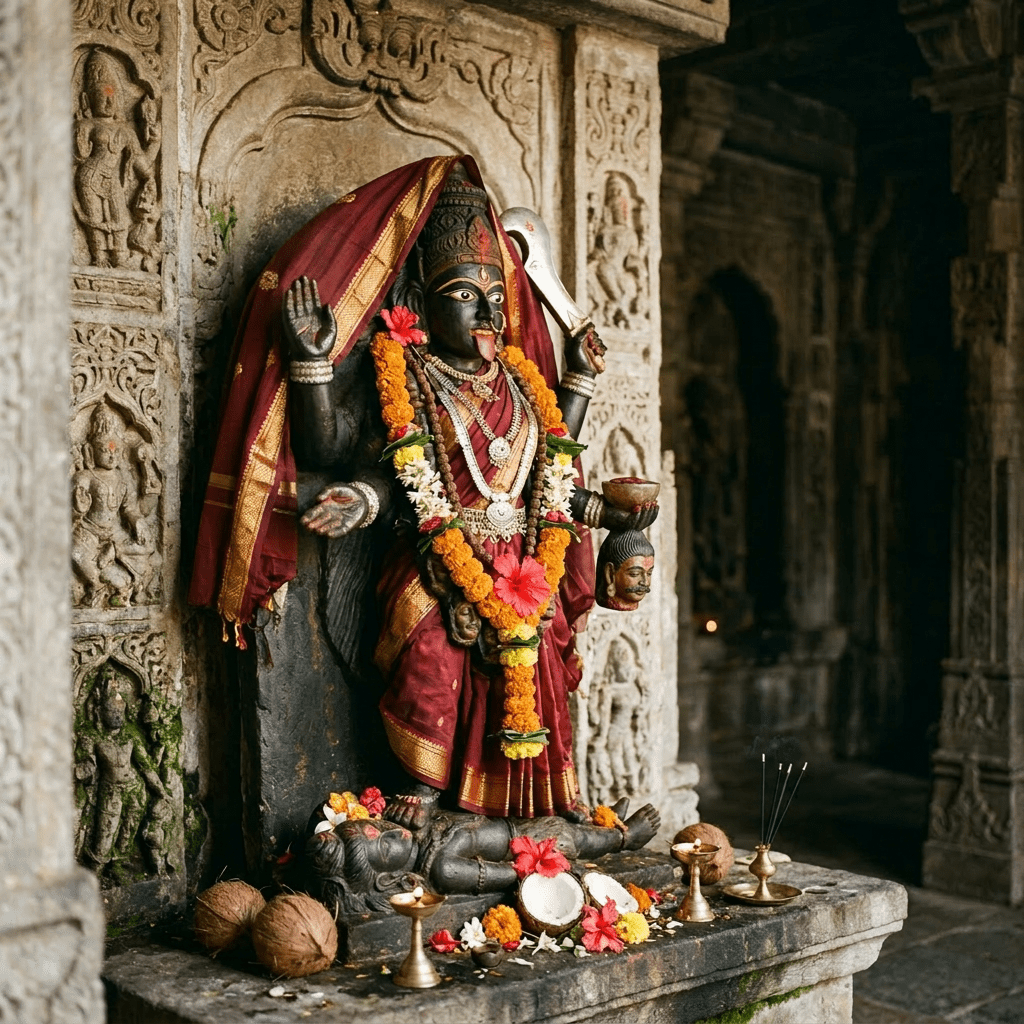
To the ordinary devotee, and even to sincere sādhakas, her form can feel like an enigma. We are told she is the most compassionate Mother, the one who protects her children fiercely. Yet when we look at her, something trembles within us. She appears terrifying to some, unsettling or even grotesque to others. But this is the beauty of Mother Kālī. She holds both extremes at once—tenderness and terror, nurture and dissolution.
This is revealed clearly in her hands. With the left, she holds the sword and the severed head. With the right, she offers boons and fearlessness to her devotees.
The garland of skulls around her neck represents the Sanskrit letters, reminding us that Mother is the source of all sound and creation. Her sword is the sharp clarity that cuts through the ego, which is enmeshed in ignorance of our true nature. The severed head is the ego itself, cut away so we can return to her. Her naked form shows that she has stripped away all illusion; she embodies the complete truth of life and death. The hands that hold her skirt symbolize the karmic impressions she removes from sincere seekers. As she stands upon her consort, Śiva, she reveals her nature as the dynamic force of the universe—the power that moves, creates, and transforms within the stillness of the Absolute.
Mother Kāli is intimately associated with death. She dwells in the cremation ground, stands upon a corpse, and bears the marks of dissolution upon her form. Through this imagery, she reveals a truth we often resist: everything in life comes to an end. Nothing we experience—whether joy or sorrow, gain or loss—remains forever. No matter how tightly we try to hold on, time loosens our grip. She shows us that impermanence is the very nature of life.
References
Sally Kempton (2013), Awakening Shakti: The Transformative Power of the Goddesses of Yoga, St. Martin’s Essentials / Sounds True.

Leave a Reply