
Many people fear Mother Kālī. Some say not to worship Her and instead to choose another form of the Divine Mother—one that is gentle, pleasing, soothing to the eyes and to the mind. Yet others say that those who pray to Mother Kālī are the brave ones. Perhaps there is some truth in this.
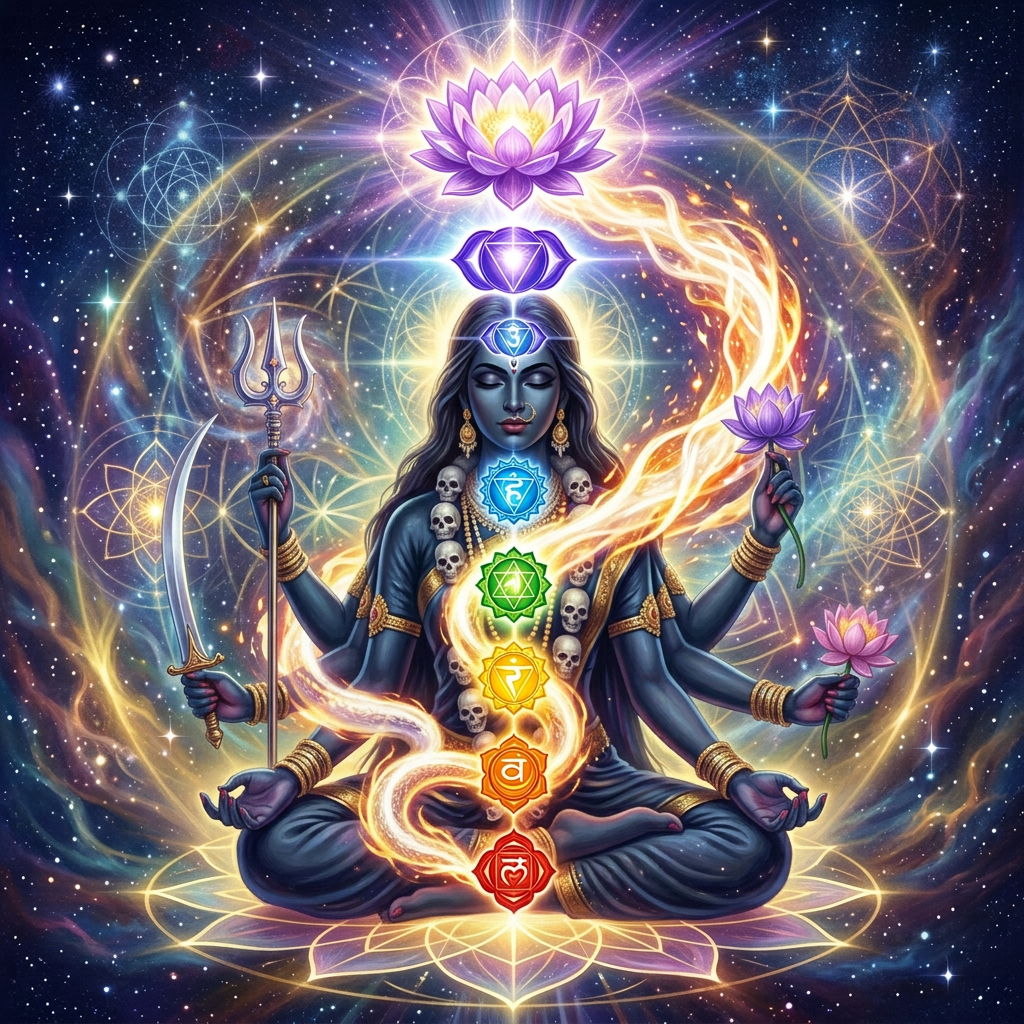
For the devotee of Mother Kālī, there are moments where the heart breaks open at the sight of Her image and simply hearing Her name fills one with longing and devotion. But this devotee of Mother Kālī also receives, now and then, the blow of Her khadga. And almost always, it hurts.
Why?
Because every strike removes something we thought we were.
Mother Kālī sees our ahaṃkāra where we cannot. Ahaṃkāra can be translated literally as “I-maker” or “the maker of I.” It is that sense of individuality which says: I am this person. I am this identity. I am separate. She sees the identities we cling to, the attachments we protect and when we call upon Her, She cuts through them. The more attached we are, the more painful the severing feels. Yet She does not strike out of cruelty. She strikes out of love. With one sweep of Her khadga, She removes one layer, then another, and then another over many turns and many seasons of life, drawing the devotee closer and closer to Her.
A sādhaka often believes that upon entering the spiritual path, they have left their ahaṃkāra behind. If before identity was built from worldly pursuits—a house, career, achievements, money, possessions, status, relationships, recognition, productivity—after entering spiritual life, ahaṃkāra simply reorganizes itself around different objects. Now identity comes from spiritual practice, scriptural knowledge, mystical experiences, discipline, devotion, or being spiritually advanced. The forms change, but the mechanism underneath remains untouched. The sādhaka often remains unaware of this. Yet the suffering remains. The striving remains.
Mother Kālī sees this too.
And so She raises Her khadga once again.
This, perhaps, is the meaning behind the severed head She holds in Her hand. It is the dissolution of ahaṃkāra. The head She carries is the “I” we bring to Her—the false center that must eventually be offered so that the devotee may enter into Her infinite being.
I am reminded of a dohā by Kabīr, the 15th-century devotional poet and saint whose verses continue to illuminate the heart of the Bhakti tradition:
Jab main thā tab Hari nahīn,
Ab Hari hain toh main nāhīn.
Sab andhiyārā miṭ gayā,
Jab dīpak dekhā māhīn.
Translation:
When “I” was, Hari (God) was not.
Now Hari is, and “I” am not.
All darkness disappeared
When I beheld the lamp within.
Kabīr points toward something profound here. As long as we remain identified with our limited individuality—with our identities, achievements, wounds, stories, and even our spiritual accomplishments—we cannot perceive the Divine fully. But when they dissolve, something astonishing is revealed: The Divine was never absent. With the end of the illusion of separation, we become aware of the light that was within all along.
Perhaps this is Mother Kālī’s deepest anugraha.

Leave a Reply