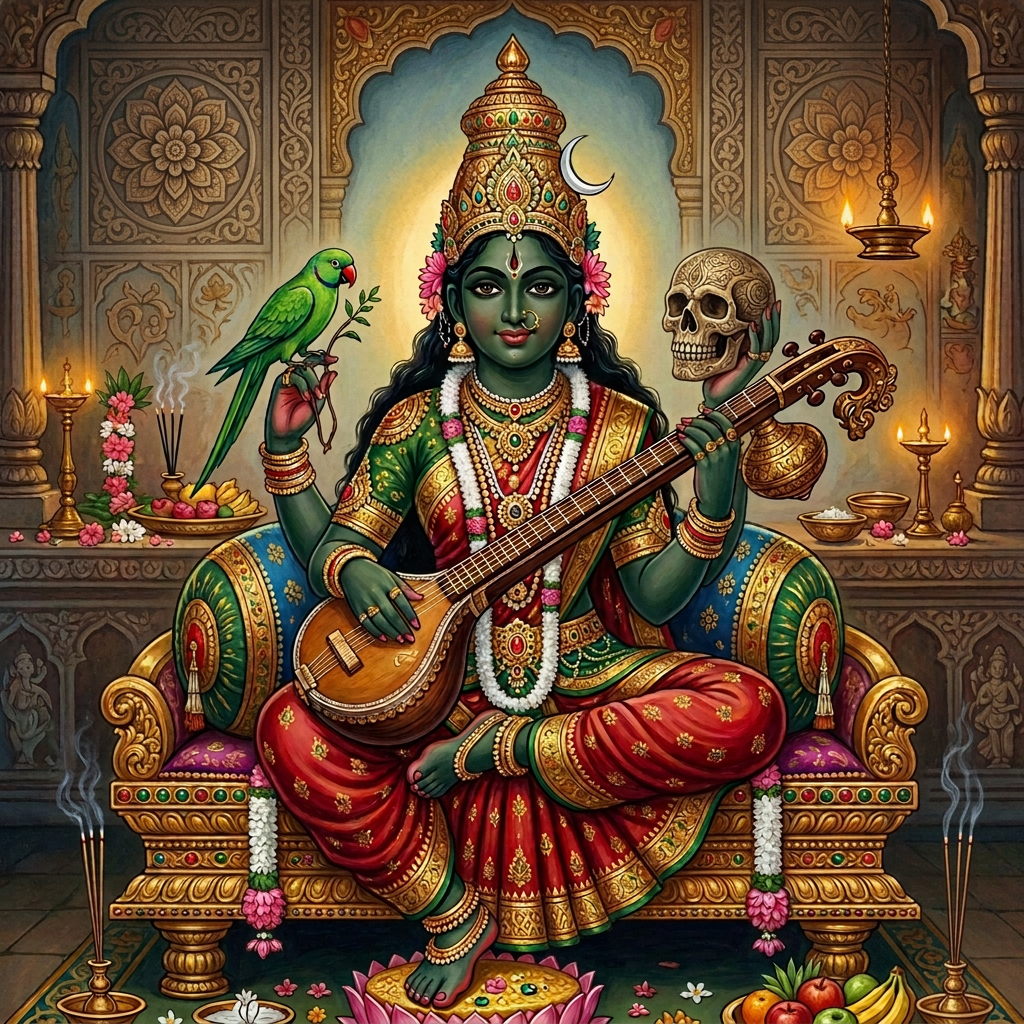
Mother Mātangī is the ninth Mahāvidyā. She is the wisdom Goddess, the Tantric form of Sarasvatī, representing buddhi—the faculty of discernment, understanding, and wisdom.
What makes Mother Mātangī particularly striking is that She is also called Ucchiṣṭa Cāṇḍālinī. Ucchiṣṭa refers to what is left over or ritually impure, while Cāṇḍālinī refers to a woman associated with the Cāṇḍāla community, a group historically placed outside the traditional caste hierarchy. Taken together, the name brings together two things that orthodox notions of ritual purity often look down upon.
It should then not be surprising that Mother Mātangī is offered leftovers, scraps, and other things considered impure or taboo such as menstrual blood. This way, She asks the sādhaka to question the very notions through which we divide the world into good and bad, pure and impure, acceptable and unacceptable. For the sādhaka who worships Mother Mātangī or undertakes Her sādhanā, this becomes a deeply introspective inquiry. Why is something considered bad? Is the thing itself inherently bad, or have we been taught to regard it as bad? She invites the sādhaka to look beneath the label.
Consider something as ordinary as a dirty room. Someone may say that having a dirty room is bad. But is a dirty room inherently bad? What is actually being judged as bad here? Perhaps it is the dust, which can contribute to allergies and, in turn, affect our health. But if we look deeper, there is another assumption: that poor health is bad. Is poor health objectively bad? Is it inherently bad in itself? Or is this judgment arising from the associations we have developed through our own experiences, our upbringing, and our culture? Nature does not make these distinctions in quite the same way. Every human being becomes ill at some point in life. Every human being experiences aging, loss, and ultimately death. These are not punishments or moral failures. They are simply movements of life.
This does not mean that the sādhaka stops cleaning the room or making distinctions that are useful in daily life. The point is not to abandon discernment or practical wisdom. Rather, Mother Mātangī asks the sādhaka to see things as they are.
The room can be cleaned because cleanliness is useful. Illness can be treated because health is valued. Yet there is a difference between responding to what is happening and becoming caught in the constant mental habit of labeling things as good or bad. When the mind is continually judging and labeling, it moves away from the experience of present moment. Instead of seeing something as it is, the mind sees it through the meanings and associations it has placed upon it. This is where Mother Mātangī’s connection with buddhi becomes especially significant. As the Tantric Sarasvatī, She represents the wisdom that can look beneath these habitual judgments. She helps the sādhaka question what the mind has simply accepted as truth and distinguish between reality and the interpretations that have been placed upon it.
In this way, one of Her blessings is the ability to see things as they are rather than falling prey to the stories of the mind. When the sādhaka begins to see this, the following verses from the Caṇḍī take on a deeper meaning:
Yā Devī sarvabhūteṣu buddhirūpeṇa saṃsthitā
Namastasyai namastasyai namastasyai namo namaḥ
O Devī, who abides in all beings in the form of intelligence and discernment,
I bow to Her, I bow to Her, I bow to Her again and again.
Mother Mātangī is the Devī who resides within us as buddhi.

Leave a Reply