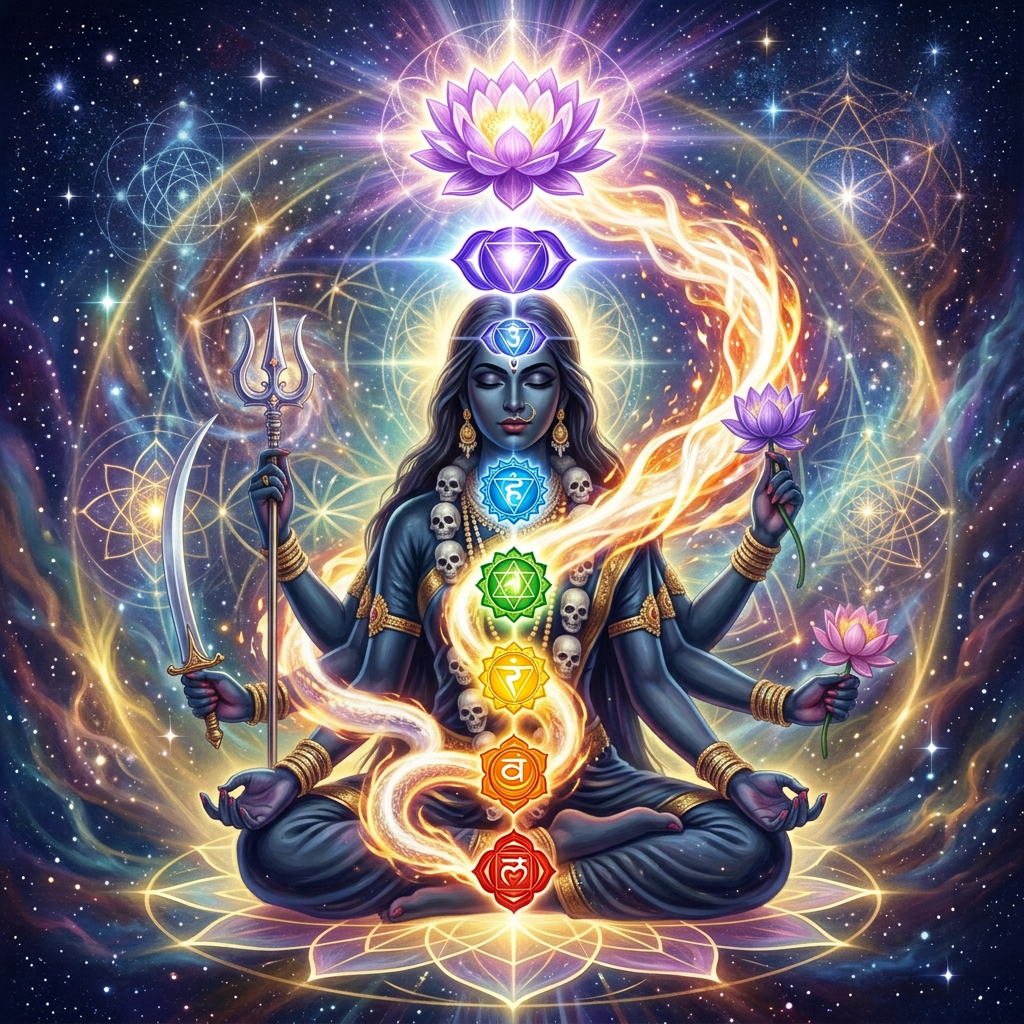
Mother Kālī is not only encountered outwardly through Her sacred image and worship, but also inwardly, within the being of the sādhaka. Within the Tantric tradition, this inner presence of Mother Kālī is known as Kuṇḍalinī Śakti.
She is said to rest in a latent form at the base of the spine, present within every being, whether one is aware of Her presence or not. The word kuṇḍa refers to a cavity or pit, while līna means absorbed or resting within. Kuṇḍalinī, therefore, refers to the Divine Mother resting quietly within the sādhaka.
For this reason, the traditional understanding of Kuṇḍalinī differs greatly from many modern interpretations. Today, Kuṇḍalinī is often presented as an energy to control in pursuit of worldly gains. The Tantric tradition, however, sees Kuṇḍalinī as the living presence of the Divine Mother. She is therefore approached with reverence, devotion, and humility.
So, Kuṇḍalinī awakening is the awakening of the Divine Mother within us. As ordinary human beings, we are often caught in qualities that are sometimes described as pāśas, such as lust, anger, greed, pride, and shame. The Divine Mother, however, is Karuṇārasasāgarā, an ocean of compassion.
Now think of Kuṇḍalinī awakening as a journey from being driven primarily by our own desires, attachments, fears, and self-interest to becoming increasingly selfless and compassionate, until our thoughts, words, and actions begin to reflect the Divine Mother, who is an ocean of compassion. I am sure you can see that this is not going to be an easy journey.
This is why Kuṇḍalinī awakening is often described as a profound “inner housecleaning.”
She reveals everything we have spent our lives avoiding: the identities that trip us, the trauma that ties us, and the fears that choke us. Things that we may have kept hidden from ourselves can no longer remain that way. They are brought into awareness in the same way She does with Her khaḍga. What Mother Kālī reveals through Her outer iconography, She accomplishes inwardly as Kuṇḍalinī Śakti.
Her khaḍga becomes the wisdom that cuts through our false identities. Her cremation ground becomes the heart where our attachments are transformed. Her supreme knowledge becomes direct realization. Her dance of dissolution and renewal unfolds within our own consciousness.
As this process unfolds in cycles, with each cycle, we shed our old identities like a snake sheds its skin. Anger, fear, resentment, and habitual reactions gradually loosen their grip. What once controlled us begins to lose its hold. The sādhaka begins to rest in a deeper sense of peace and inner harmony.
With this comes a deeper knowing and felt sense of the Divine Mother within the sādhaka. Mother Kālī no longer feels like a distant deity, but as the living presence within the sādhaka’s body and mind.
So, in its truest essence, the awakening of Kuṇḍalinī is to become one with the Divine who lives in us as us. In other words, the awakening of Kuṇḍalinī is the awakening of the Divine Mother’s own power, revealing the truth that was always present.
Only the sādhaka who has walked this path can truly know what this means: when the greatest Śakti awakens within their very being.
For some, it is said that the awakening of Kuṇḍalinī reveals hidden creativity, insight, wisdom, and a greater capacity to practice compassion and forgiveness.
The great story of Veda Vyāsa comes to mind. During the composition of the Mahābhārata, it is said that the verses flowed out of him like an unbroken stream, one after another. The outpouring was so extraordinary that he asked Gaṇeśa to become his scribe because he himself could not keep up with the flow of his own composition. Whether we take this story literally or symbolically, it gives us a beautiful image of creative power flowing through a human being with extraordinary force.
Perhaps this is what it means for the Divine Mother to awaken within us. What She brings forth may be different for each sādhaka, but the source is the same. It is Her Śakti moving through us, revealing what She has always held within us.
References
Chinnaiyan, K. (2019). Glorious alchemy: Living the Lalitā Sahasranāma. New Sarum Press.
Swami, O. (2016). Kundalini: An untold story. Jaico Publishing House.


Leave a Reply