Tantra asks us to see the Divine not only in what we find beautiful and pleasant, but also in what we fear and reject. This challenges our natural tendency to move toward what we desire and away from what we fear.
We spend much of our lives imagining and constructing our future. We think about what we want to achieve and gain, and how we want our lives to unfold. Yet there are also many things we desperately hope to avoid. We do not want to grow old. We do not want to experience loss. We do not want to be alone.
And this is where we encounter the seventh Mahāvidyā, Mother Dhumāvatī.
She is old, wrinkled, alone, and a widow.
Pause for a moment and think about that. A widow goddess. A form of the Divine who represents abandonment, loss, and everything that we don’t want to think about.
It is then not surprising that there is often fear associated with praying to Mother Dhumāvatī, performing Her sādhanā, or even calling upon Her, especially for those living with families, responsibilities, and attachments.
Interestingly, Mother Dhūmāvatī is closely associated with Alakṣmī1 which means “not Lakṣmī.” We are all familiar with Devī Lakṣmī and Her symbolism. She represents prosperity, beauty, auspiciousness, and the blessings that we naturally seek in life. In Śrī Sūktam, one of the hymns dedicated to Devī Lakṣmī, verse five says:
Chandrāṃ prabhāsāṃ jvalantīṃ śriyaṃ loke devajuṣṭām udārām |
Tāṃ padminīmīṃ śaraṇam ahaṃ prapadye alakṣmīr me naśyatāṃ tvāṃ vṛṇe ||
Translation:
“I seek refuge at the lotus feet of the Goddess who is as beautiful and radiant as the moon, who blazes with illustriousness, who is adored by the gods and exceedingly munificent. May my misfortunes end, I invoke thee.”2
At this point, many sādhakas make the mistake of equating Mother Dhumāvatī with misfortune itself. But to do this is to misunderstand Her completely. It would also contradict Her very place among the Mahāvidyās, the Great Wisdom Goddesses.
The Mahāvidyās reveal the deeper truths of life. If we pause and reflect, we see that life is never just one thing. There is joy and sorrow, gain and loss, birth and death. Just as Śrī reveals the abundance of life, Mother Dhumāvatī reveals those aspects of life we would rather avoid. Yet these too are expressions of the same Divine.
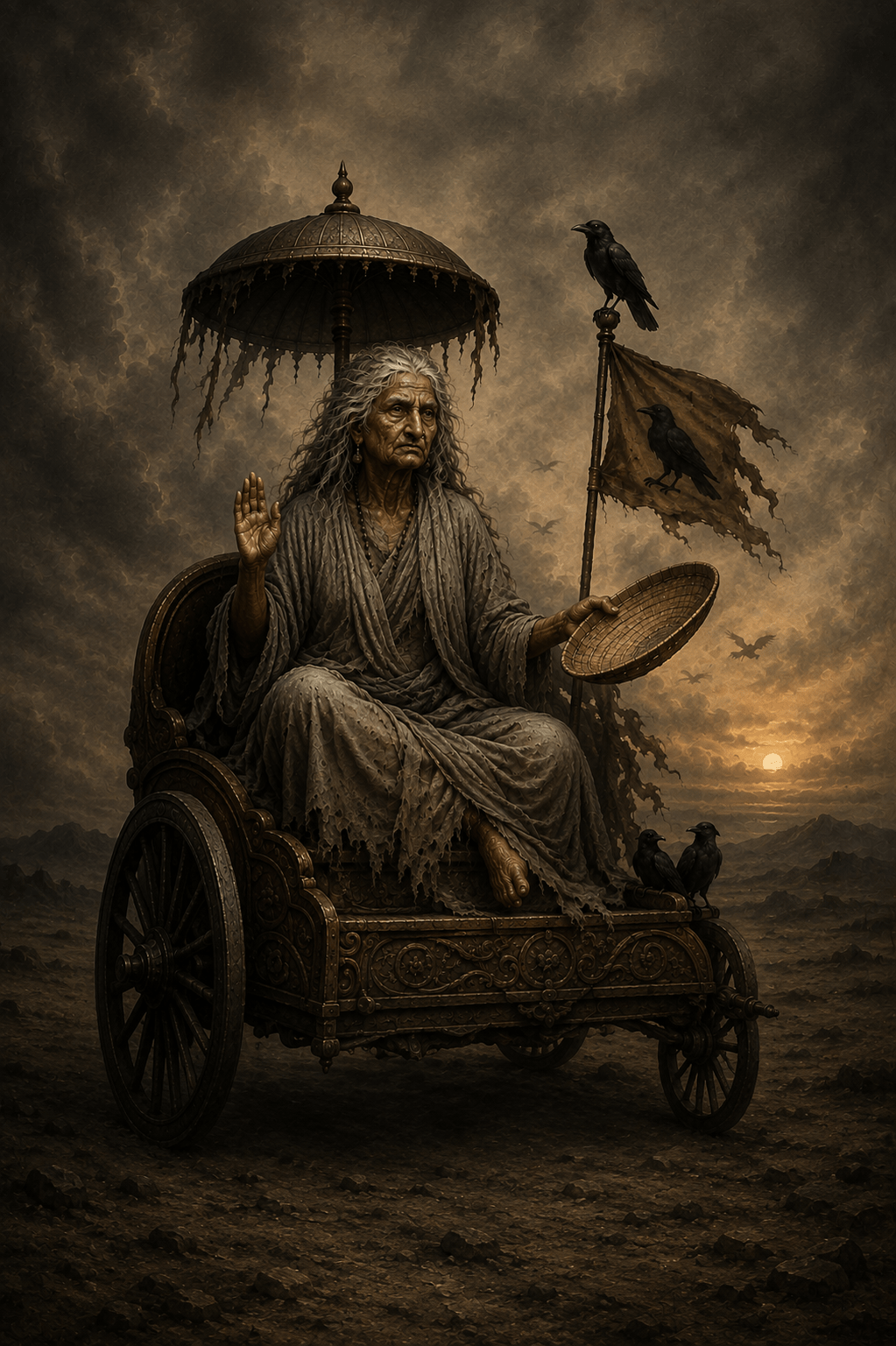
One of the ways Mother Dhumāvatī reveals this teaching is through Her iconography. She is often described as having long teeth, a long nose, and fearsome eyes. She wears dirty clothes, and Her breasts hang down. She is always hungry and thirsty and appears unsatisfied. She rides a chariot bearing a banner topped with a crow emblem, but the chariot is halted with nowhere to go. In one hand, She holds a winnowing basket, while with the other She makes the gesture of conferring a boon.3
As we sit with this description, we may notice uncomfortable emotions arising within us. Hunger, thirst, dirtiness, and the crow, with its association with death, can all evoke negative feelings. It would not be surprising if Her form brings up disgust, fear of loneliness, ageing, loss, or any other uncomfortable emotions. But if we pause, we may notice something important. These emotions can only arise if they already exist within us. Just as a winnowing basket separates the grain from the chaff, Mother Dhumāvatī reveals what already exists within us so that we can separate what serves us from what keeps us from living a wholesome life. If we are willing to participate in this process of winnowing, She offers us Her boon. That boon is inner harmony, where instead of rejecting parts of ourselves, we learn to meet them and live in acceptance of all that life offers. And perhaps then we begin to see that the Divine was never present only in what we called beautiful and auspicious. She was present in all of it, even in what we feared, rejected, and wished to leave behind.
References

Leave a Reply