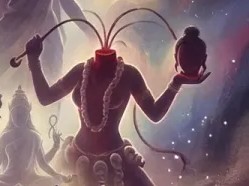
In my posts on the Inner Mystery of Devī Chinnamastā and the Origin of Devī Chinnamastā, I explained Her form, its esoteric meaning, and the story of Her origination. I recommend reading those posts before reading this one because the intensity of Mother Chinnamastā’s imagery is reflected in Her sādhanā.
Mother Chinnamastā is depicted as severing Her own head, and Her very name reflects this imagery. Chinnamastā means “She whose head is severed.” Her form represents a radical act of self-offering as the ultimate nourisher of the universe.
Therefore, through Her sādhanā, the sādhaka is invited into this same process of offering.
When we say that we offer our head to Mother Chinnamastā, it is not a literal offering. Rather, it is the symbolic offering of the ideas we hold about who we think we are. The head becomes significant because it is where our thoughts, concepts, beliefs, and identities are formed. It is where we constantly create and reinforce ideas about ourselves.
What is ultimately being offered is not the physical body, but our attachment to the limited identity created by ahaṃkāra.
Ahaṃkāra can be translated literally as “I-maker.” It is that sense of individuality that creates the feeling: “I am this person. I am this identity. This is who I am.” I have written about this in my post The Khadga of Mother Kālī, where I discuss the cutting away of this limited identification.
In Khanda Munda sādhanā, the sādhaka symbolically offers their body parts into the purifying fire. This main sādhanā can be undertaken for 21 days on the Tantra Sādhanā app. Before beginning this process, the sādhaka first chants Mother’s mantra and performs Her yagna for 11 days to build a relationship and bond with Her.
Because the purpose of this sādhanā is to loosen our identification with ahaṃkāra, the sādhaka may begin to experience different aspects of their identity coming to the surface. Whatever we have built our sense of self around, especially those places where we feel limited, incomplete, or unable to expand, may begin to reveal themselves. For example, if our identity is deeply connected to a particular belief about who we are, or if it is rooted in a feeling of not being good enough, these emotions may arise during the process.
This is not separate from the work of the Devī. These aspects of ourselves are brought forward so that they can be seen, understood, and ultimately released.
Something else is also being revealed through this process. The One who is free from a particular limitation can truly remove that limitation from another. One who is still bound by something cannot completely liberate another from the same bondage.
The Devī’s ability to remove these limitations arises because She Herself is beyond them.
Mother Chinnamastā is nirahaṃkāra, without ahaṃkāra. She has transcended the limited identification of “I” and “mine.” Because She is free from this sense of separation, She has the power to guide the sādhaka beyond their own ahaṃkāra through the offering made in Khanda Munda sādhanā.
We also see this principle reflected in the names of the Devī found throughout Her different forms and in Her sahasranāmas. For example, in the Lalitā Sahasranāma, which contains the thousand names of the Devī in the form of Lalitā Tripura Sundarī, some of Her names include Niṣpāpa Pāpanāśinī, Niṣkrodhā Krodhaśamanī, and Nirmohā Mohanāśinī.
These names describe Her as the One who is free from pāpa and destroys pāpa. Although pāpa is often translated as “sin,” this translation is limited and can carry connotations that do not fully align with how the term is understood in Vedic and Tantric traditions. They also describe Her as the One who is free from anger and destroys anger, and the One who is without delusion and destroys delusion. Here, delusion refers to our identification with ahaṃkāra.
The same principle applies to Mother Chinnamastā. She is able to lead the sādhaka beyond ahaṃkāra because She Herself is beyond it.
As one of the Mahāvidyās, Mother Chinnamastā’s purpose is to lead the sādhaka toward supreme knowledge. Therefore, anything that stands in the way of that realization may naturally come to the surface. Any emotions, fears, or painful memories that arise during Her sādhanā are part of Her work.
The challenge for the sādhaka is to learn to see all of it as Her anugraha. Although anugraha is often translated as “grace,” this translation is limited and does not fully capture the depth of the term within Vedic and Tantric traditions. Anugraha refers to the compassionate action of the Divine Mother toward the sādhaka, guiding and supporting their movement toward Truth, even when that process comes through experiences that may appear challenging.
And this is the gift of Mother Chinnamastā’s Khanda Munda sādhanā.

Leave a Reply