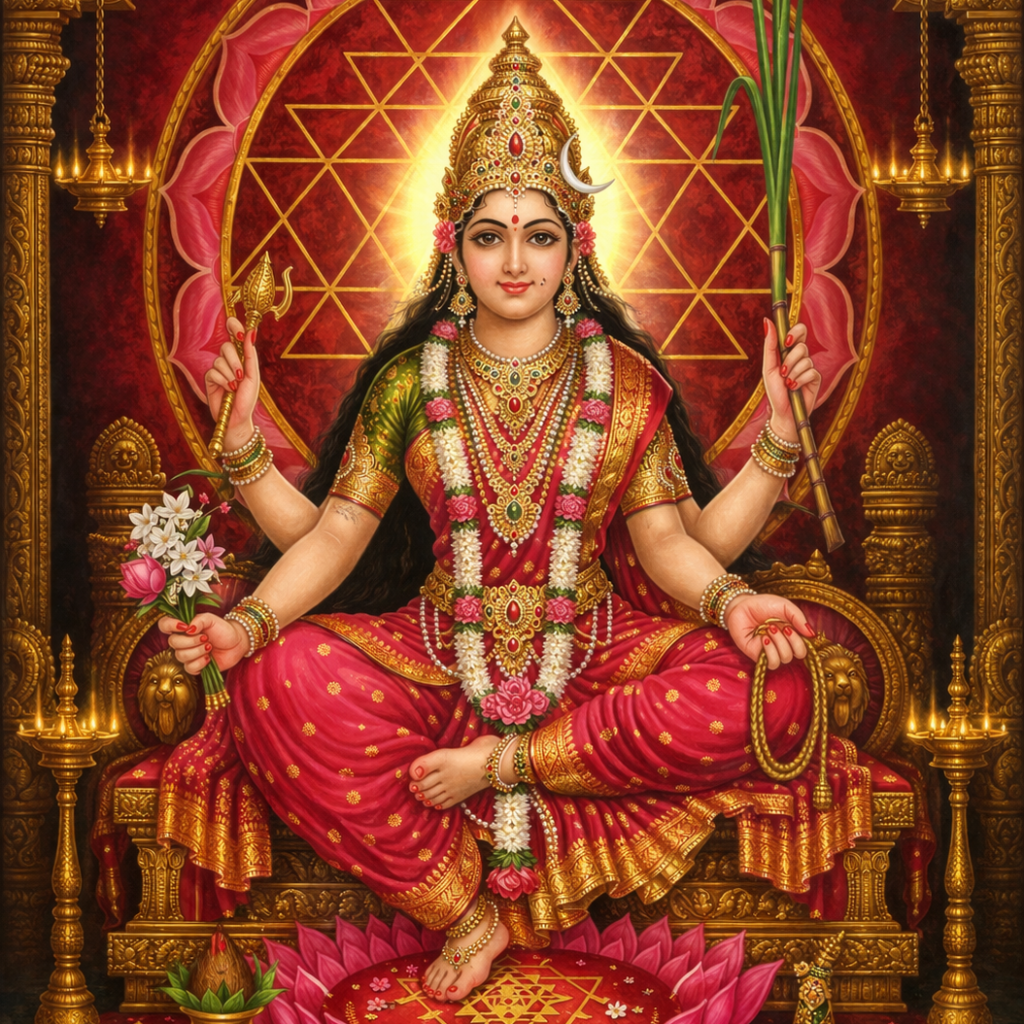
The Lalitā Sahasranāma is a sacred hymn of the Mother Goddess. It contains the thousand names of Devī in the form of Lalitā, Tripura Sundarī, Rājarājeśvarī.
It begins and ends with Mother.
The first name is Śrī Mātā—the auspicious Mother.
The final name is Ambikā—Mother.
At the most basic level, a mother is the one through whom life is carried, given form, and brought into the world. The word itself often carries an imprint of care, safety, and origin.
When Devī is approached in the form of a Mother, a relationship of mother and child is formed inwardly. In that relationship, care and safety begin to arise naturally in the mind of the seeker.
When there is care and safety, the way we meet life begins to shift. The world feels less like a threat, and more like something that can be explored, lived in, and moved through with openness.
The name Lalitā in Lalitā Sahasranāma means the playful one.
Kavitha Chinnaiyan’s book Glorious Alchemy: Living the Lalitā Sahasranāma contains the Sahasranāma along with its literal and deeper meanings, as well as contemplative practices. Chanting the Sahasranāma regularly can be a life-changing experience. This is not an overstatement.
As she writes:
“Chanting it becomes a meditation (dhyāna) where the object of concentration takes us from the superficial level of the mind to the depths of inner repose, to eventually facilitate the ‘turning upon itself’ of attention. The subtle inner form of the deity is visualized to become the object of meditation, bringing the mind to its Source, the One Absolute, beyond all limited concepts.”

Leave a Reply